Our home and native land
 Are Canada's native people on the brink of a new era of health, wealth and respect?
Probably not. But then, things can hardly get much worse.
Five hundred chiefs of the Canadian Assembly of First Nations has re-elected Phil Fontaine National Chief at their gathering in Vancouver today (check the Reuters article here). It remains to be seen whether he will manage to bring some relief to the people he represents. Meanwhile, a United Nations vote supporting the rights of indigenous people everywhere has been rejected by Canada (check the Reuters article here), for fear that the non-binding resolution will cede Canada's sovereignty over its national resources to First Nations.
It was only a few years back that Canadians recoiled at criticism from a UN report that natives living on reserves were living in similar conditions to that of the developing world. Since then, things haven't gotten much better. Native life spans are 7.5 years shorter on average than the rest of the population, reflected in high poverty rates, rampant drug and alcohol dependency, overrepresentation on welfare rolls and in prisions, dilapidated housing and infrastructure on reserves... the list goes on and on.
The roots of the problem go back to the days of first contact. To put things in perspective for those who may not appreciate the scale of the catastrophe that befell the native people (ie. "why can't 'these people' get their act together after 500 years?"), imagine the world as it is today.
The continents are populated by a great assortment of people at various stages of wealth and development, generally peaceful but certainly capable of violent conflict both inside and outside their borders. In the wealthiest societies, the people have even achieved a great measure of personal comfort and happiness and even spiritual enlightenment.
Then the Martians came.
They didn't look all that different from the people of earth. Aside from their skin color and a few minor genetic differences, humans and Martians would have looked virtually indistinguishable.
But they were different than anything humans had ever encountered.
Some of the Martians were warlike and hungry to conquer new lands with their technologically advanced weaponry. They saw humans as no different than the other strange animals populating the earth.
Other Martians just wanted to get rich by trading with the locals. They understood that the humans might even be sentient beings like themselves - and besides, in the interest of paying the mortgage on their vacation homes back on Phobos, it might be more convenient to keep the humans around to do the grunt work of extracting the resources they needed.
The warlike Martians killed humans at the slightest provocation. When the humans would fight back with their inferior fighter planes and tanks, the Martian war machines would destroy entire cities to avenge their losses.
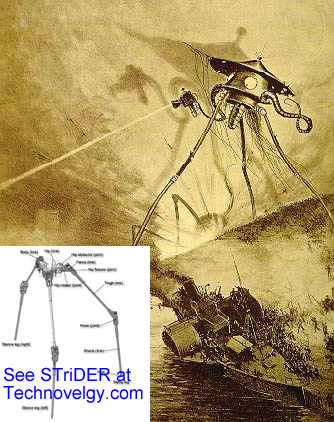
New York disappeared in a blast of heat and light. Tokyo sank into the ocean. All of the capitals of Europe succumbed in clouds of poison gas.
The trading Martians mostly kept quiet about that, so long as there were enough humans left over elsewhere to make a profit from - or the empty lands left behind still had resources in them worth mining.
The warrior Martians did their bit, but it was the scourge of their own Martian viruses inadvertantly released on the locals really brought humanity to the brink of extinction. In some cities, less than one in 20 inhabitants survived the strange diseases.
The Martians, meanwhile, built up their outposts into their own bizarre-looking artificial cities. The few remaining humans were gathered up and encouraged to settle on land fit for neither agriculture nor involvement in the dynamic Martian economy. Even the traditional occupations of human society no longer made sense when Martians could easily replicate technologically superior products, and the only currency that mattered was Martian Platinum. The internal economy of the last remaining humans collapsed. Out of desperation, many of the survivors learned the Martian language and customs well enough to continue their existence on the fringes of an alien society.
Centuries passed. Humanity's plight became more and more desperate. A few highly-ranked Martians had even come around to champion the human's cause and pity the poor race that they had displaced. Some of these decided that the only hope of humanity's survival was to assimilate even further into Martian society and abandon their old culture. They opened re-education centres where human children would be sent to learn Martian knowledge and culture.
 Some humans actually seemed to benefit from it and emerged into Martian society as functional, even prosperous adults. Some couldn't make the transition into the alien society and retreated into the recesses of pitiful humanity. Many more were traumatized by their experience, as a good number of the very Martians who were supposed to educate them treated the humans to the most despicable practices of their own world.
Only a few decades later, the smallest improvements begin to appear in human society. Many of them are still relegated to the fringes of Martian society. But a small number of human leaders have even managed to become successful members of that society. While their population will never again challenge the numbers of Martians, human societies are starting to stabilize and even grow into self-sustaining communities (amounting to 4.4 per cent of the population of Martian society).
Many Martians may still carry negative perceptions of the original people of Earth, but more educated Martians have begun to see tragedy that their ancestors wrought long ago. Humans' rights are recognized and Martian laws ensure that humans actually get some advantages over Martians in some sectors of the Martian economy. Resources are set aside to ensure that the worst deprivations that take place on human reserves become a thing of the past.
Will the humans of Earth ultimately get the chance to stand as equals with the Martians in what was once their own land?
This science fiction story isn't over, yet.
tags: Mars attacks, colonization in Canada, First Nations, Native Canadians, first contact, cultural genocide, aboriginal title, Canadian history, Canadian Assembly of First Nations, Phil Fontaine, indigenous people
posted by Jonathon Narvey @ 7:31 PM


2 Comments:
At 5:29 PM, Anonymous saidâ¦
So native people are genetically inferior to Eurpean martians? Sounds like racism to me. Yeah yeah I know, someone else's great-great-great-great-granparents gave the natives a raw deal - but that is the history of the entire world, not just North America. 500 years is a long time for first "nations" to wait for someone to assimilate. Actually assimilate is the wrong expectation since native's quality of life and population have greatly increased in that time. So what exactly is the point of your essay? If it is to induce guilt then sorry, there are much greater injustices in the world that receive my charity.
At 11:18 PM, Jonathon Narvey saidâ¦
Dear anonymous,
Interesting... I write that the humans and Martians have a few genetic differences" and you infer that the humans (ie. natives) are genetically inferior. If you look carefully at what I wrote, you'll see no mention of genetic superiority by the Martians (ie. Europeans) - only a technological edge expressed particularly through weaponry. I thought of the "genetic differences" I mentioned as cosmetic (eg. causing different skin color - green, perhaps?)
But your response - inferring that natives are genetically inferior - indicates a predisposition towards one way of thinking. Who's the racist?
The point of my essay was to foster understanding, not guilt. Thanks for reading.
Post a Comment
<< Home